
Publish it!
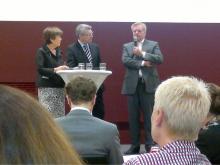
Corruption in development cooperation is not the favourite topic of donor agencies. But the willingness to address this thorny topic is growing. On the 13th of June the German Ministry of Economic Cooperation and Development (BMZ) launched its new anti corruption strategy and invited about 100 corruption experts from governmental and private organisations to discuss it. The strategy is based on multi-stakeholder consultations and clearly demonstrates the political will of the BMZ to tackle this major obstacle to development.
In the debate Meinhard Remberg, the representative of the association of manufacturing companies, explained that private investors are often confronted with unclear regulations as to what constitutes corruption and what doesn't. Cobus de Swardt, the director of Transparency International offered a common sense solution to this challenge. If you can publish it, de Swardt argued, it is probably ok. For example, if business partners don't object to read about gifts, invitations, etc. in the newspaper, there is probably no corruption going on.
This rule of thumb does not only work as a test for corruption. It can also work to prevent corruption. This basic concept of “publish it” is already applied as a means to fight corruption at the local level, at the national level and at the international level. At the local level transparency about the community services like education (number of teachers at a school, school fees to be paid and government funding allocated to an individual school) reduces corruption in this sector. At the national level budget transparency is the basis for community monitoring. Bottom up accountability is gaining importance in the fight against corruption and access to information is a precondition for successful citizen's monitoring. Secretary of state Beerfeltz stressed, that if we cannot fight corruption from the top, we will use a bottom-up approach. Bottom-up accountability is supported by corruption research by Michael Kramer,according to whom most corruption cases are disclosed by local insider knowledge.
At the international level both the Extractive Industries Transparency Initiative (EITI) and the International Aid Transparency Initiative (IATI)are based on the assumption, that publication of financial data will change the incentives of stakeholders and increase their integrity. Accordingly, secretary of state Beerfeltz highlighted this importance of IATI as one key element of Germany's anti-corruption strategy in his key note address.
IATI can help to reduce the corruption in development cooperation in several ways. At the policy level the transparency of aid donors improves the allocation of aid monies in line with anti-corruption principles. According to Jörg Faust from the DIE more transparent donors tend to give more aid to less corrupt countries with good governance indicators. The publication of planning documents for new development projects allows parliamentarians and civil society watch dogs to question the policy choices of partner governments that may be influenced by corrupt practices. The publication of implementing agencies in partner countries can be used to identify double financing of projects and sole sourcing in procurement. Studies by Michael Tierney et al. even show a correlation between donor transparency and general corruption levels in partner countries. IATI will also support the prevention and detection of corruption during project implementation by allowing an overview of who is implementing which project at sub-national level, what the overall budget is and which disbursements have been made. This information is a precondition for any bottom-up accountability.
Ten years ago, transparency and accountability has not been high on the agenda. It is now. As Cobus de Swardt put it, the Zeitgeist of our time is a fertile ground for bold transparency initiatives and for decisive progress in fighting corruption. Data is not the cure for all ills. Nobody claims that. But it holds a lot of potential for a less corrupt world. We have to seize this opportunity. Lets publish. A lot. In open formats! Now!
- Claudia Schwegmann's blog |
- Add new comment |
- 996 reads
-

- Cite |
 |
| 